
Risk-Based PAT Testing: Smarter Compliance for Your Business
Move away from unnecessary, one-size-fits-all annual testing.
By following the latest IET Code of Practice (5th Edition) and Health and Safety Executive (HSE) guidance (HSG107), I build tailored, risk-based Portable Appliance Testing schedules that keep your workplace safe, legally compliant, and cost-effective.
What is Risk Based PAT testing?
Many duty holders still assume the law requires every electrical plug in the building to be tested every 12 months. Under the Electricity at Work Regulations 1989, there is no strict legal rule mandating annual testing for every appliance. Instead, maintenance intervals must be proportionate to the risk of the equipment becoming damaged.
Testing a stationary office monitor every year wastes your budget and disrupts your team. Conversely, a handheld power tool on a busy workshop floor or a kettle in a commercial kitchen needs much closer inspection. A risk-based schedule ensures high-risk items get regular attention while low-risk equipment moves onto extended testing cycles.
How the Patco 3-Level Risk Assessment Works
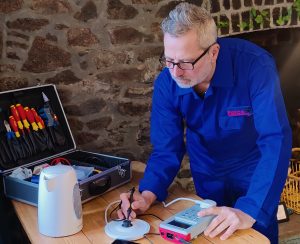
When our engineers visit your site, we do much more than apply pass stickers. On your first visit, we carry out an item-by-item assessment to create a complete Electrical Asset Register. Each appliance is evaluated based on its environment, construction class, movement frequency, and user type, then assigned one of three clear risk levels:
Level 1: High Risk (Tested Every 6–12 Months)
- What this covers: Handheld power tools (drills, grinders, sanders), commercial kitchen appliances, vacuum cleaners, and extension leads used in harsh, damp, or dusty areas.
- Why it matters: Frequent flexing, heat, moisture, and heavy daily handling increase the risk of cable wear and electrical faults.
Level 2: Medium Risk (Tested Every 12–24 Months)
- What this covers: Everyday workplace appliances such as portable heaters, desk fans, staff room microwaves, laptops, and public-facing equipment in hotels or rental properties.
- Why it matters: Moderate movement and regular unplugging require routine formal visual checks and periodic electrical testing.
Level 3: Low Risk (Tested Every 36 Months)
- What this covers: Stationary, double-insulated (Class II) IT equipment in clean, dry offices, including desktop monitors, docking stations, servers, and wall-mounted screens.
- Why it matters: Because these items rarely move and sit in low-traffic environments, they carry minimal risk of mechanical damage.
What You Receive After Every Patco Visit
- Itemised Asset Register: Every appliance is logged by location, description, equipment class, risk rating, and exact next due date.
- Defensible Audit Trail: Clear, structured compliance reports ready for HSE inspectors, commercial insurers, landlords, and accreditation bodies.
- Reduced Long-Term Costs: You stop paying for unnecessary annual tests on low-risk office equipment and only schedule visits when items are genuinely due
- Duty Holder Sign-Off Summary: An easy-to-read executive cover sheet explaining the reasoning behind your bespoke testing intervals.
Frequently Asked Questions About Risk-Based PAT Testing:
Does my commercial insurer still require annual PAT testing?
Some insurance policies, lease agreements, and trade accreditations stipulate annual testing regardless of HSE risk guidance. We always advise checking your policy wording—and if your insurer requires a 12-month cycle, we can tailor your Patco schedule to match.
What happens if an appliance is moved to a different environment?
If a low-risk office item is moved into a workshop, kitchen, or damp storage area, its risk profile changes immediately. Our asset register makes it simple to upgrade that item to Level 1 or Level 2 on your next inspection.
Do staff still need to check equipment between Patco visits?
Yes. Informal User Checks before daily use remain an essential part of electrical safety. We encourage staff to look out for frayed cables, cracked casings, or scorch marks and report them immediately.
Ready to Switch to Risk-Based PAT Testing?
Get clear compliance documentation without overpaying for blanket testing.
Get in touch today to book your risk based PAT testing.