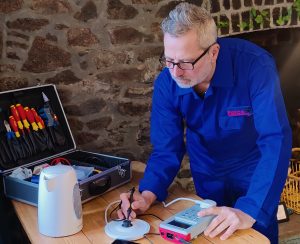

What Does a PAT Tester Actually Do?
What Does a PAT Tester Actually Do During a Visit? More Than Just Plugging In a Machine
If you’ve ever wondered what actually happens when a PAT tester visits your premises, this guide explains the process from start to finish. I’ll take you through the individual checks and electrical tests carried out on an appliance
PAT testing is more than simply plugging an appliance into a testing machine and checking whether it passes or fails and sticking a label onto an appliance. A proper inspection involves examining the appliance, checking its electrical connections, carrying out appropriate electrical safety tests, assessing the results and recording the outcome.
Here is a breakdown of what happens when I inspect and electrical test an appliance
1. Identify and assess the appliance
Before any testing takes place, I identify the appliance and establish what type of electrical equipment it is.
This includes considering:
- The type of appliance and its intended purpose.
- Whether it is Class I (earthed) or Class II (double insulated).
- Its operating voltage and power rating.
- Whether it has a detachable power cable.
- Its working environment and how frequently it is used.
- Any specific manufacturer testing requirements.
This is important because different appliances have different electrical safety requirements. For example, an earthed appliance requires an earth continuity test, whereas a double-insulated appliance does not.
2. Record important information regarding the appliance on a data record.
The following is identified and recorded on the PAT testing record:
- Appliance unique identification number
- Appliance description
- Date of test
- Serial number, if specified
- Appliance Location
- Appliance class
- Cable Length, this is measured and recorded
- Cable conductor diameter, this may be required later in the electrical test and is used to help determing the fuse rating
- Fuse value
- Risk assessment risk level, this is used to determine the frequence of visual and combined testing.
3. Carry out a thorough visual inspection
A visual inspection is one of the most important parts of PAT testing. Many electrical faults can be identified without using a testing machine.
I examine the appliance, its plug and its connecting cable for signs of damage, deterioration or unsafe construction.
Plug inspection
Checking the plug for cracks, damage or signs of overheating.
Checking that the correct fuse rating is fitted.
Inspecting the fuse and fuse holder.
Checking that the cable is securely clamped.
Inspecting accessible internal wiring connections where appropriate.
Looking for loose connections, exposed conductors or damaged insulation.
Cable inspection
Checking for cuts, abrasions, splits or damaged insulation.
Looking for signs of crushing, stretching or excessive bending.
Checking that the cable is securely attached to the appliance.
Looking for signs of overheating or deterioration.
Appliance inspection
Checking the casing for cracks, damage or missing components.
Looking for exposed electrical parts.
Checking switches, controls and connectors for damage.
Looking for signs of overheating, liquid ingress or contamination.
Checking that the appliance is suitable for its working environment.
If a potentially dangerous defect is identified, the appliance should not proceed to electrical testing until the issue has been assessed. It may need to be removed from service.
4. Carry out an earth continuity test (Class I appliances)
Class I appliances rely on an earth connection to provide protection against electric shock if an electrical fault occurs.
Examples include many kettles, desktop computers, washing machines and metal-cased appliances.
I use a dedicated test instrument to check that there is a continuous, effective electrical connection between the earth pin of the plug and the exposed conductive parts of the appliance that require earthing.
The test helps identify problems such as:
A broken or disconnected earth conductor.
A loose earth connection.
A damaged cable.
Poor electrical connections within the appliance.
An acceptable result confirms that the protective earth connection has the required continuity.
This test is not applicable to Class II double-insulated appliances, which do not rely on a protective earth connection.
5. Carry out an insulation resistance or appropriate alternative test
Insulation is designed to prevent electricity from reaching parts of an appliance that people could touch.
Over time, insulation can deteriorate due to age, heat, mechanical damage, moisture or general wear and tear.
An insulation resistance test checks the condition of the electrical insulation by applying a controlled test voltage and measuring the resistance.
Depending on the appliance, its construction and the manufacturer’s instructions, I may use:
An insulation resistance test.
A protective conductor current test.
A touch current or alternative leakage current test.
The appropriate method must be selected carefully. Some electronic appliances contain sensitive components that could be damaged by an unsuitable insulation test voltage.
The objective is to establish that the appliance does not present an unacceptable risk of electric shock due to defective insulation.
6. Carry out any additional electrical tests where required
Not every appliance requires exactly the same tests.
Depending on the equipment, additional checks may include:
Polarity testing on extension leads and detachable lead sets.
Leakage current measurements.
Protective conductor current measurements.
Functional checks to confirm that the appliance operates correctly.
Additional checks appropriate to the equipment design.
The tester needs to understand which tests are relevant and how to interpret the results.
For example, an extension lead requires different checks from a desktop computer, and a sensitive electronic appliance may require a different testing approach from a simple electric kettle.
7. Evaluate the test results
Once the inspection and appropriate electrical tests have been completed, I evaluate the results.
The readings obtained from the PAT tester must be considered alongside the visual inspection findings and the type and construction of the appliance.
A pass or fail decision should not simply be based on whether a testing machine displays a green light.
I assess what the results mean and whether the appliance is suitable for continued use.
If an appliance fails, it should be clearly identified and removed from service until it has been appropriately repaired, replaced or otherwise dealt with.
8. Record the results
The final stage is to record the outcome of the inspection and testing.
A typical PAT testing record includes:
The results of the relevant tests.
Whether the appliance passed or failed.
Any observations or faults identified.
A PAT test label may also be attached to the appliance to identify it and indicate the inspection date and result.
These records provide a useful history of the appliance and help establish appropriate future inspection and testing requirements.
Frequently Asked Questions About PAT Testing
Does every appliance need to be PAT tested every year?
No. There is no universal legal requirement for annual PAT testing. Inspection and testing intervals should be determined by risk, taking account of the appliance, its environment, how it is used and previous results.
👉 Read more about risk-based PAT testing
Can risk-based PAT testing save money?
Yes. By assessing appliances individually, it may be possible to extend inspection and testing intervals for suitable low-risk equipment, reducing unnecessary testing costs.
Who carries out visual inspections between PAT testing visits?
What is the IET Code of Practice, 5th Edition?
It is recognised guidance for the in-service inspection and testing of electrical equipment. It covers risk assessment, inspection and testing procedures, and appropriate inspection and testing intervals.
What happens if an appliance fails a PAT test?
An appliance that fails should be clearly identified and taken out of service until the fault has been assessed and appropriately resolved. Depending on the circumstances, it may need repair, further investigation or replacement.
Does PAT testing involve more than using a testing machine?
Yes. A proper inspection includes a visual examination, selection of appropriate electrical tests, assessment of the results and recording the outcome. The tester needs to understand the appliance and interpret the results rather than simply relying on the machine’s pass or fail indication.
How often should my appliances have visual inspections?
This depends on the type of appliance, how it is used and the environment in which it operates. As part of my risk-based approach, I provide individual recommended visual inspection schedules so your staff know when routine checks should be carried out.